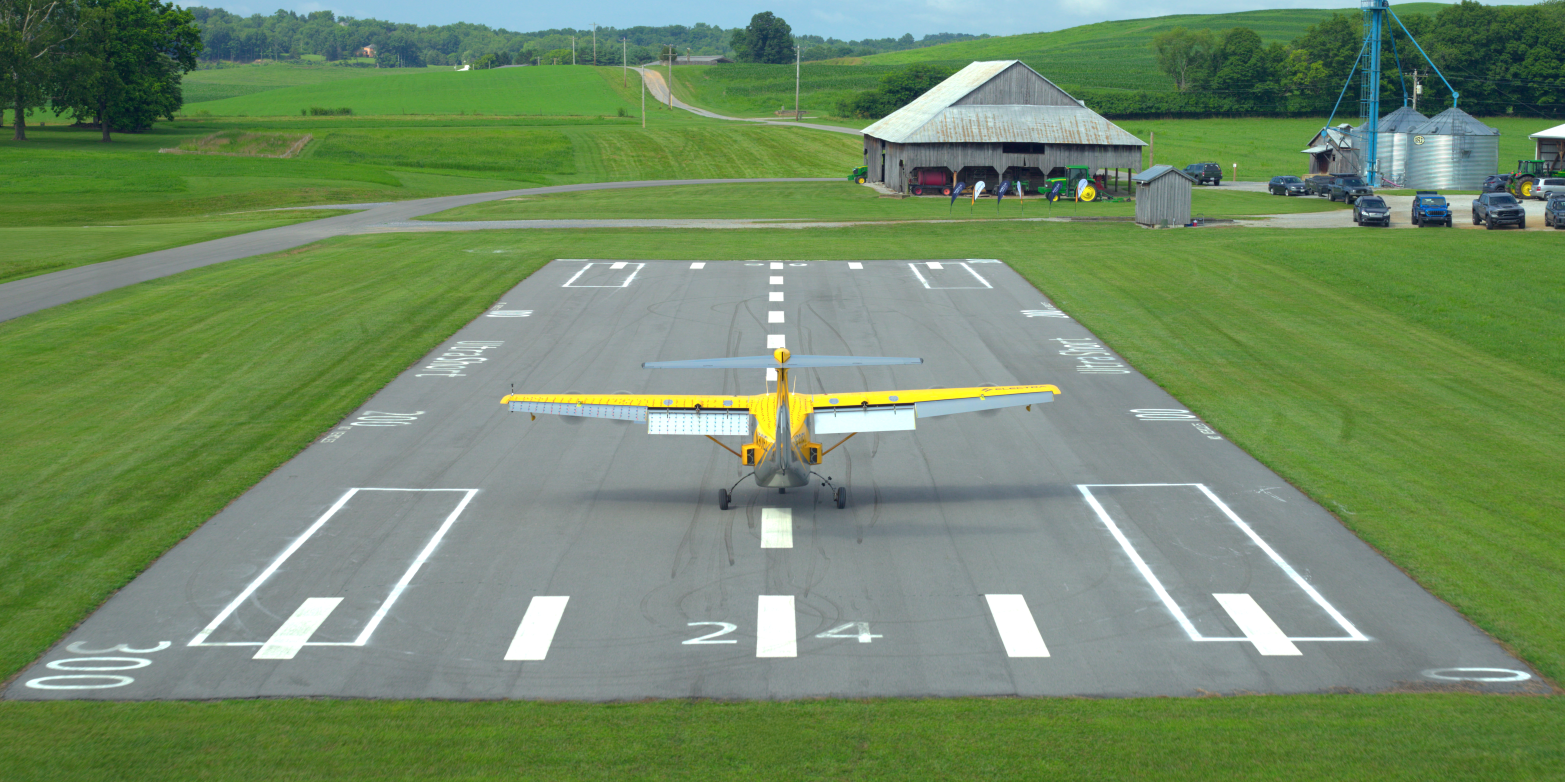
Electra’s EL-2 Goldfinch technology demonstrator has completed another round of flight testing, this time demonstrating the ultra-short takeoff and landing performance that could make hundreds of rural airfields viable nodes in a future air mobility network.
The flights, conducted in November 2025, showcased operations from airfields dramatically smaller than conventional airports. Electra says the final version of its commercial aircraft will operate from surfaces as small as 300 x 100 feet – about one-tenth the length of a standard airport runway. That is roughly the size of a football field.
The demonstrations build on Electra’s earlier work with Surf Air Mobility at Virginia Tech, where the two companies completed the first commercial demonstrations of ultra-short takeoff aircraft.
How It Works
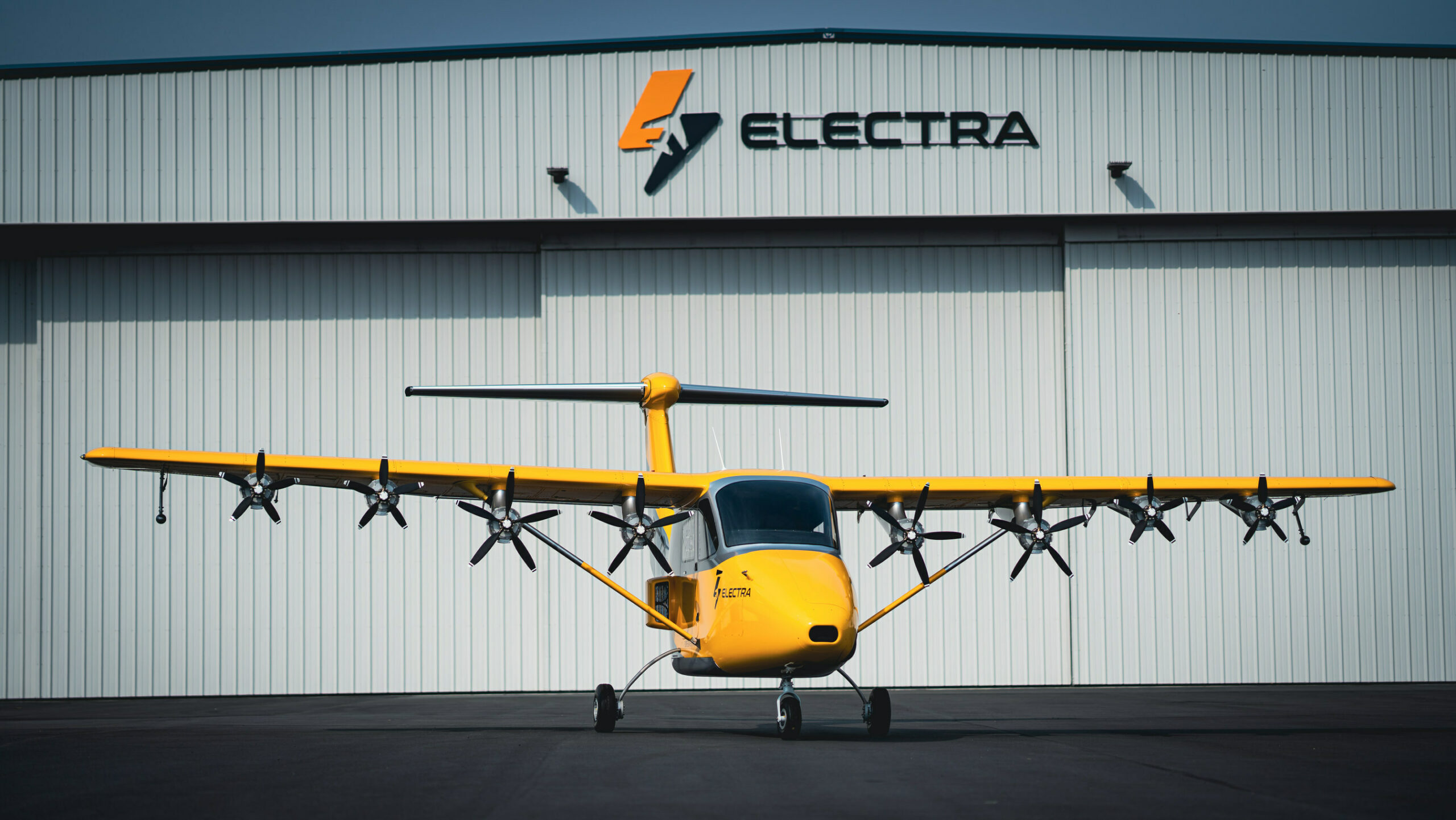
Electra’s blown-lift technology is the key differentiator. Eight electric motors drive propellers mounted along the leading edge of the wing, blowing high-velocity air over the wing surface at low speeds. This generates the lift needed for takeoff and landing in distances that would be impossible for conventional aircraft – or even most eVTOL designs that require vertical thrust.
During cruise flight, a turbine generator takes over, providing power for speeds up to 200 mph and a range of 500 miles. The hybrid-electric approach means Electra does not face the range limitations that constrain pure-battery eVTOL designs.
The company is now developing a full-scale pre-production aircraft under its $85 million AFWERX Agility Prime partnership with the U.S. Air Force. A full-scale prototype flight is targeted for 2026, with certification under FAA Part 23 and commercial entry into service planned for 2028.
The Rural Infrastructure Advantage
This is where eSTOL’s value proposition becomes most clear. Consider what rural communities already have:
Private grass strips. The FAA’s database lists thousands of private airfields across rural America. Most are simple grass or turf strips used for agricultural aviation, personal flying, or emergency access. Many meet the 300-foot minimum Electra requires.
Municipal airfields. Small-town airports that lost scheduled service decades ago still have paved surfaces, lighting, and basic facilities. These are ready-made eSTOL stations.
Agricultural land. A flat, compacted section of farmland can serve as a temporary or seasonal operating surface. Electra’s low ground roll means no paving is required.
No vertiport needed. Unlike eVTOL aircraft that need purpose-built vertical landing pads with charging infrastructure, eSTOL aircraft use conventional – just much shorter – runways. This eliminates the single largest infrastructure barrier to rural air mobility.
The contrast with eVTOL deployment is stark. Building a vertiport costs millions and requires zoning, grid connections, and ongoing maintenance. An eSTOL-ready airfield might already exist in your county.
Nine Seats Changes the Math
Most eVTOL aircraft carry one to four passengers. Electra’s nine-seat configuration makes a fundamentally different kind of service possible:
- Scheduled regional routes connecting rural towns to hub airports
- Charter service for business travelers, medical patients, or agricultural professionals
- Cargo runs carrying medical supplies, equipment parts, or perishable goods (1,360 kg capacity)
At nine seats, the per-passenger cost of a flight drops to a level where subsidized Essential Air Service-style operations become economically practical.
What to Watch
- 2026: Full-scale prototype flight
- 2028: Targeted commercial entry into service
- eIPP participation: Electra has been named as a partner in multiple eVTOL Integration Pilot Program proposals. Selections are expected in early 2026.
The Bottom Line
eVTOL captures the imagination. eSTOL captures the airfields. For rural communities with existing strips and fields, Electra’s approach offers the shortest path from today’s infrastructure to tomorrow’s air mobility network. No new construction required.
Electra is headquartered in Manassas, Virginia. More information: electra.aero