Vertical Aerospace’s latest piloted prototype flight is not just another eVTOL milestone. It is a signal that the industry is starting to build for longer routes, heavier payloads, and communities beyond the urban air taxi map.
Vertical Aerospace has put another full-scale aircraft into piloted flight testing. That would normally read like a straightforward certification update: one more prototype, one more test campaign, one more step toward commercial service.
But the more important story is what Vertical plans to do next.
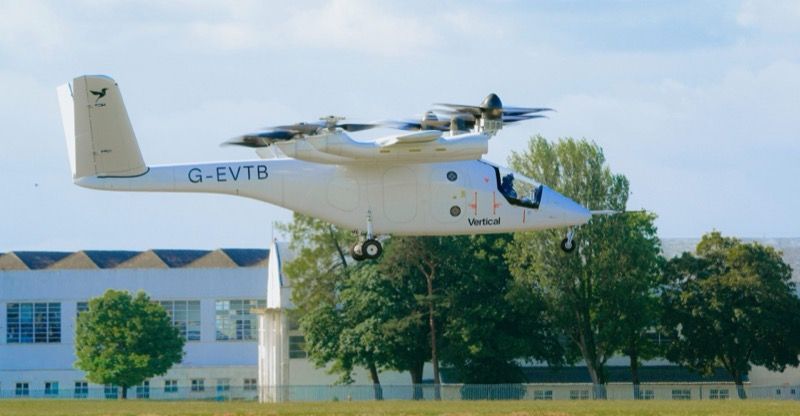
The UK-based company announced this month that its latest full-scale prototype completed its maiden piloted flight at Vertical’s Flight Test Centre in the United Kingdom on June 5, following a new Permit to Fly from the UK Civil Aviation Authority. The aircraft is the final full-scale prototype before Vertical completes Critical Design Review, the milestone that sets the design baseline for certification and clears the path toward its first pre-production aircraft.
That alone matters. Vertical says the new aircraft doubles its flight-test capacity and will help validate thrustborne, wingborne, and transition flight. But for rural air mobility, the key line came later in the announcement: after completing its all-electric test phases, Vertical intends to retrofit the aircraft for hybrid-electric flight testing.
The company says the hybrid-electric variant is expected to support missions that demand greater range and payload capability across defense, logistics, and wider commercial markets.
That is where the rural story begins.
Electric Air Taxis Have a Range Problem
The first wave of eVTOL development has been shaped around short urban trips. Airport to downtown. Downtown to convention center. Suburb to business district. These are valuable markets, and they are easier to model because demand is dense, route lengths are short, and infrastructure can be concentrated at a small number of high-traffic locations.
Rural logistics is different.
A medical supply route between a regional hospital and an outlying clinic may run 120 miles each way. A cargo route across the Mountain West may need to cross long stretches with no charging infrastructure. A wildfire response or utility repair mission may need to reach a remote site, loiter, divert, and still return safely. Agricultural support flights may need payload more than speed.
Those are not natural fits for today’s battery-only eVTOL economics.
Vertical’s all-electric Valo platform is aimed first at passenger service, with four seats and certification work through the UK CAA and the European Union Aviation Safety Agency. The company has emphasized airline-level safety standards, simplified propeller systems, and battery technology built through its Vertical Energy Centre.
But battery-electric aircraft face the same basic physics that shape electric trucks: range, payload, temperature, charging time, and reserve requirements all trade against one another. In dense cities, that trade can work. In rural networks, it often does not.
That is why hybrid-electric propulsion deserves attention.
What Hybrid-Electric Actually Changes
Vertical has been testing a next-generation hybrid-electric propulsion system at its Hybrid Propulsion Evaluation Rig, known as HYPER, at Cotswold Airport. The company says the system integrates a sustainable aviation fuel-compatible gas turbine, generator, electrical systems, control architecture, and software.
In plain terms, the turbine generates electricity for the aircraft’s electric propulsion system. The batteries still matter, especially for peak power, vertical lift, and safety redundancy. But the aircraft is no longer dependent only on stored battery energy for the entire mission.
Vertical has described the target capabilities for the hybrid-electric variant as up to 1,000 miles of range and up to 1,100 kilograms of configurable payload. Those are company targets, not certified performance numbers. They should be treated as development goals until flight testing and regulatory approval prove them out.
Still, the direction is significant.
A 1,000-mile target moves the aircraft from an air taxi conversation into a regional logistics conversation. A 1,100-kilogram payload target moves it closer to real freight use cases: medical supplies, spare parts, high-value agricultural inputs, emergency equipment, and time-sensitive cargo that is too urgent for a truck but too small for conventional air cargo.
For rural communities, that combination matters more than a seven-minute downtown flight.
The Rural Use Cases Are Not Theoretical
The strongest near-term rural applications for advanced air mobility are not likely to be commuter passenger routes. They are likely to be logistics routes where time, distance, and poor ground access create measurable costs.
Three categories stand out.
Medical and pharmacy logistics. Rural hospitals and clinics routinely face long courier runs for lab samples, medications, blood products, and specialty equipment. A hybrid-electric aircraft with meaningful payload and regional range could connect clinics to hub hospitals without requiring every county to build a full commercial air service model.
Utility and infrastructure response. Rural electric cooperatives, pipeline operators, telecom networks, and rail corridors all maintain assets across wide, low-density geographies. A vertical-lift aircraft that can carry tools, sensors, or repair components to remote sites could reduce response times when roads are flooded, blocked, or simply too slow.
High-value agricultural and industrial cargo. Many rural businesses do not need bulk air freight. They need fast movement of specific parts, diagnostic equipment, veterinary supplies, or crop inputs when a delay stops work. A hybrid-electric aircraft does not need to replace trucks. It only needs to beat them when the cost of waiting is higher than the cost of flight.
That is the key distinction. Rural air mobility does not have to be universal to be useful. It has to serve the routes where distance and urgency make conventional transport inefficient.
Why This Could Fit Rural Airports Better Than Urban Vertiports
The United States already has a vast aviation footprint outside major cities. The FAA notes that more than 5,000 public-use airports support the national aviation system, and many of them are small general aviation airports located in or near rural communities.
That existing network is one of rural America’s underused infrastructure advantages.
Urban air taxi service requires expensive vertiport development, grid upgrades, community noise approvals, and dense passenger demand. Rural logistics may be able to start from simpler assets: existing runways, municipal airports, county-owned facilities, hospital landing areas, and industrial pads.
Vertical-lift capability still matters because it can open sites without runways. But the rural advantage is not just vertical takeoff. It is flexibility. A hybrid-electric aircraft could operate from an airport when that is most efficient, from a prepared pad when proximity matters, or from a temporary operating area during emergency response.
That flexibility is especially important in regions where a 40-mile road trip can take 90 minutes because of terrain, weather, or road quality.
The Trade-Off: Cleaner Than Conventional, Not Zero-Emission
There is an important caveat. Hybrid-electric aircraft are not the same as all-electric aircraft.
A turbine burning fuel, even sustainable aviation fuel, means local emissions and fuel supply chains remain part of the operating model. For communities evaluating AAM infrastructure, that distinction matters. A hybrid-electric aircraft may offer lower emissions, lower noise, and better operating efficiency than conventional helicopters or small aircraft, but it should not be marketed as zero-emission.
The trade-off is practical rather than ideological.
Battery-only eVTOLs offer the cleanest operating profile but remain constrained by energy density, charging availability, and reserve requirements. Hybrid-electric aircraft bring back fuel logistics and added mechanical complexity, but they may deliver the range and payload needed for rural missions today, not after a decade of battery breakthroughs.
For rural counties and fleet operators, the right question is not which technology sounds most futuristic. It is which one can move the required payload, over the required distance, with the required reliability, at a cost that can be justified.
Hybrid-electric may answer that question sooner.
Certification Remains the Hard Part
Vertical’s progress is meaningful, but it is not a commercial launch.
The company still needs to complete Critical Design Review, build its first pre-production aircraft, validate the hybrid-electric retrofit through testing, and secure certification for any commercial variant. The hybrid version adds additional complexity because regulators will need to evaluate the turbine, generator, battery integration, control architecture, failure modes, and operational procedures as a system.
The company is targeting certification with the UK CAA and EASA. Any U.S. commercial implications would depend on future FAA acceptance, validation, or separate certification pathways.
That means rural communities should watch the technology closely but avoid planning around unproven timelines.
The useful takeaway is strategic: the market is beginning to recognize that one aircraft type will not serve every AAM mission. Urban air taxis, regional cargo aircraft, medical logistics platforms, and emergency response vehicles may share electric propulsion technology, but they need different range, payload, infrastructure, and certification models.
Vertical’s hybrid-electric work is one example of that shift.
What Rural Leaders Should Watch Next
For county officials, airport managers, rural health systems, and economic development teams, the immediate action is not to buy into a specific aircraft. It is to prepare for the operating questions that hybrid-electric logistics will raise.
First, airports should understand their current power, fuel, hangar, and emergency response capacity. Hybrid-electric aircraft may reduce dependence on high-capacity chargers, but they will not eliminate infrastructure needs.
Second, communities should identify real route problems. Which lab samples are delayed? Which parts stop work? Which road corridors fail during storms? Which hospitals, farms, mines, utilities, or tribal communities face repeated transport bottlenecks? AAM pilots will be strongest where the problem is already measurable.
Third, local leaders should track certification and insurance requirements before signing exclusivity agreements. Early infrastructure deals can shape markets for years. Rural landowners and municipalities should preserve flexibility while the aircraft landscape is still evolving.
Finally, rural communities should push AAM companies to publish mission-relevant data, not just headline range numbers. Useful metrics include payload at range, turnaround time, reserve policy, maintenance intervals, operating cost per flight hour, noise profile, fuel type, and weather limits.
Those are the numbers that determine whether hybrid-electric aircraft become a rural logistics tool or another demonstration technology.
The Bottom Line
Vertical Aerospace’s latest piloted prototype flight matters because it moves the company closer to certification. Its hybrid-electric plan matters because it points toward the missions rural communities actually need.
Battery-electric air taxis may define the public image of advanced air mobility. But rural air mobility will be won on range, payload, dispatch reliability, and infrastructure practicality.
If Vertical can prove its hybrid-electric targets in flight testing, the conversation changes. The aircraft is no longer just a cleaner way to cross a city. It becomes a possible bridge between rural clinics and regional hospitals, between remote utility sites and repair crews, between small airports and the logistics networks that bypass them today.
That is the range remedy rural air mobility has been waiting for.
Sources
- Vertical Mag, “Vertical Aerospace’s final full-scale prototype completes first piloted flight,” June 2026.
- Vertical Aerospace, “Vertical Aerospace Advances Hybrid-Electric Testing and Battery Production,” May 2026.
- Vertical Aerospace, “Meet Valo.”
- Federal Aviation Administration, public-use airport planning materials.