—

This week, advanced air mobility moved decisively from conceptual planning to concrete operations along rural corridors. For community planners, agricultural managers, and local infrastructure coordinators, the most critical developments were not speculative press releases, but actual medical logistics flights, formalized FAA certification agreements, and localized low-altitude defense and precision agriculture programs. Advanced flight networks are proving that regional air mobility will be built on practical infrastructure, local landing rights, and sustainable biological inputs.
BETA Technologies Kicks Off FAA’s eIPP with Multistate Medical Flights
The Federal Aviation Administration’s highly anticipated eVTOL Integration Pilot Program (eIPP) transitioned into live operations this week. Vermont-based BETA Technologies, in partnership with United Therapeutics and the Multistate Collaborative eIPP National Integration Complex, completed the first operational flights of the program using its ALIA CX300 conventional takeoff and landing (CTOL) electric aircraft.
The demonstration campaign covered a rigorous 275-nautical-mile corridor across Maryland and Virginia. Flights operated between Virginia Tech/Montgomery Executive Airport (KBCB) in Blacksburg, Virginia; Charlottesville-Albemarle Airport (KCHO); Frederick Municipal Airport (KFDK) in Maryland; and Martin State Airport (KMTN) near Baltimore. Designed to transport manufactured medical organs, these missions highlight the potential for zero-emission aviation to serve time-critical regional supply chains. For rural healthcare networks, this pilot provides a real-world template for bypass flights that circumvent congested highways, connecting regional farm hubs and mountain communities directly to specialized medical centers.
Electra Secures Swift FAA Approval for EL9’s G-1 Certification Basis
Hybrid-electric short-takeoff aircraft manufacturer Electra announced that the FAA has closed the G-1 Issue Paper for its nine-passenger EL9 “Ultra Short” aircraft. Achieving this milestone just seven months after submitting its Part 23 type certification application establishes a firm regulatory foundation. It outlines how the FAA will evaluate several of Electra’s core design innovations, including distributed hybrid-electric propulsion, blown-lift flight mechanics, and advanced fly-by-wire low-speed handling.
The G-1 closure represents a major victory for regional airport viability. Because the EL9 is designed to operate from runways as short as 150 feet, it bypasses the need for high-cost vertical landing infrastructure. By formally accepting the certification basis under Part 23, the FAA confirms that hybrid-electric eSTOL aircraft have a validated, predictable pathway to commercial flight. This regulatory certainty is a powerful signal for small airports looking to position themselves as regional cargo and passenger hubs.
Electra, UrbanV, and Signature Aviation Partner on Regional Route Rollout
Immediately preceding its FAA milestone, Electra signed a Memorandum of Understanding with fixed-base operator Signature Aviation and vertiport developer UrbanV. The trio plans to build a point-to-point regional flight network, dubbed “Direct Aviation,” specifically targeting journeys between 50 and 250 miles – where driving is highly inefficient and traditional commercial flight is non-existent.
The partnership integrates three distinct elements: Electra’s 330-nautical-mile-range hybrid aircraft, UrbanV’s vertiport configurations, and Signature’s global footprint of FBO terminals. By embedding compact, low-noise “Ultra Short” access points directly near existing communities and business parks, the group hopes to bypass city-center congestion. For rural county planners, this provides an immediate blueprint: small communities can integrate low-cost municipal airstrips or paved vertipads into existing business corridors, linking local economic centers directly to Signature’s global terminal network.
South Dakota Mines Launches Multi-Layered Drone Research for Soil Health
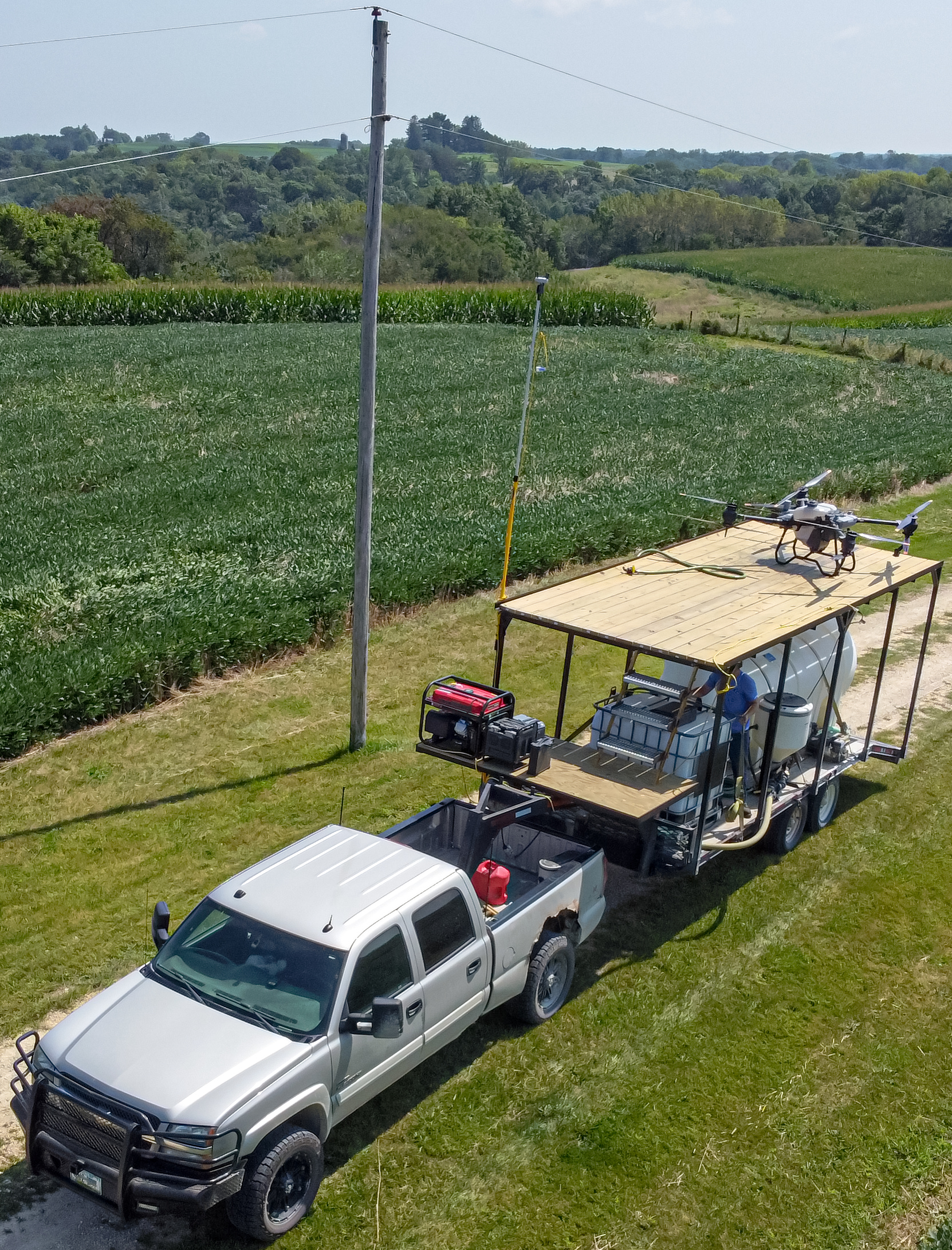
On the agrarian front, researchers at South Dakota Mines are shifting the focus of agricultural drone flight from simple aerial imagery to deep soil restoration. Under the National Science Foundation-funded AMiTSA program – a $4 million collaborative effort involving Sitting Bull College, North Dakota State, and South Dakota State – engineering doctoral student Zach Karg and fellow researchers are deploying custom-built drones equipped with multispectral cameras alongside ground-level cavity ring-down spectroscopy (CRDS).
The multi-layered approach allows drone teams to pinpoint plant stress, water scarcity, and nitrogen deficiencies before they become visible to the eye. Instead of recommending traditional, high-cost chemical fertilizers, researchers are developing microbial consortia. These microscopic organisms convert locked-up nutrients already present in the soil into water-soluble forms. Applying these specialized biological agents precisely where drones detect deficiencies helps farmers cut rising input costs, minimize soil degradation, and run sustainable ag operations.
Interim cUAS Rules Introduce New Aviation Standards for Low-Altitude Flight
The U.S. Departments of Homeland Security and Justice jointly issued an interim final rule establishing a standardized framework for counter-unmanned aircraft systems (cUAS) operations. Empowered by the 2025 NDAA, the rule grants eligible state, local, tribal, and territorial (SLTT) law enforcement and correctional agencies the authority to integrate drone detection and mitigation systems into local airspace.
Importantly for the advanced air mobility community, the Vertical Aviation International (VAI) has noted that cUAS operations and jamming activities often occur below 400 feet AGL – exactly where utility inspections, cargo drones, and future eVTOL networks expect to operate. The new rule establishes a two-tiered system: local agencies may track drones after online training, but active mitigation (disabling or taking control of aircraft) requires rigorous, FBI-led national certification and direct line coordination with the FAA to ensure that low-altitude public operations are not mistakenly targeted as hostile threats.
What This Means for Rural Communities
This week’s milestones demonstrate that the advanced air mobility ecosystem is shifting from an engineering debate to an operational reality. Real-world medical deliveries along the Virginia-Maryland corridor, type-certification progress for runway-independent eSTOL aircraft, and the creation of regional landing partnerships show that flight networks are being organized today. At the same time, precision ag drone networks and new low-altitude security restrictions indicate that empty low-altitude airspace is quickly becoming an active, coordinated resource.
For rural leaders, the takeaway is simple: wait-and-see is no longer a viable strategy. Local governments should move quickly to evaluate local zoning rules for vertiports, assess electrical grid capacity for fast-charging installations at municipal airports, and actively participate in regulatory discussions – such as the cUAS comment period and state AAM planning initiatives – to ensure their communities are positioned to benefit from this new era of direct regional transport.
Related Reading on Rural Air Mobility News
- The Range Remedy: Why Vertical’s New Hybrid-Electric Focus Matters for Rural Logistics – background on how hybrid-electric propulsion unlocks rural flight distances.
- FAA Part 108: The BVLOS Rule That Could Unlock Rural Drone Operations – deep dive on the upcoming beyond-visual-line-of-sight framework.
- Texas TxDOT’s Multi-Phase AAM Plan: From Cargo to Medical to Air Taxis – how state programs are preparing infrastructure before operations begin.